Statues - Hither & Thither |
Site Search:
|
|
Marktredwitz
Lkr. Wunsiedel im Fichtelgebirge Bayern Fikentscherstraße 24 |
Egerlandbrunnen - Chebská KašnaEgerland Fountain |
Hatto Zeidler & Christoph Zeidler
2005 |
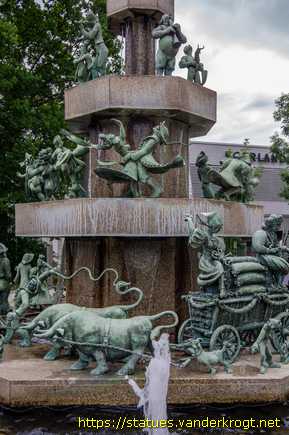
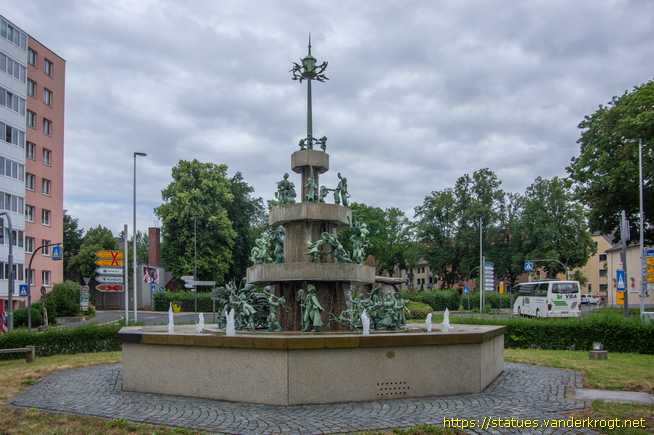
Achteckiger Granitbrunnen mit einem Durchmesser von etwa 7 m und einer Höhe von 6 m. Auf vier Ebenen stehen 52 Bronzefiguren. Zusammen stellen sie eine traditionelle Egerländer Bauernhochzeit dar. Oben befindet sich ein Taubenhaus mit fliegenden Tauben, ein traditionelles Element auf Egerländer Bauernhöfen.
Anmerkung: Egerland ist das Gebiet der Stadt Eger, auf Tschechisch Cheb.
An octagonal granite fountain measuring approximately 7 m in diameter and 6 m high. 52 bronze figures stand on four tiers. Together, they depict a traditional Egerland peasant wedding (Egerländer Bauernhochzeit). At the top stands a dovecote with flying pigeons, a traditional feature of Egerland farms.
NB: Egerland is the region around the town of Eger, known as Cheb in Czech
.
Der folgende Text wurde von der ausführlichen Tafel am Brunnen übernommen; dazwischen haben wir die Fotos eingefügt.
The following text has been taken from the detailed information board by the fountain; we have inserted the photographs between the lines of text.
Anlässlich des Egerlandtages wurde der Egerlandbrunnen am 3. September 2005 eingeweiht. Das Thema des Brunnens ist eine "Egerländer Bauernhochzeit".
Die entsprechenden Figuren wurden hierzu auf vier Ebenen aufgegliedert.
The Egerland Fountain was unveiled on 3 September 2005 to mark Egerland Day. The theme of the fountain is an 'Egerland peasant wedding'.
The figures depicting the scene are arranged across four levels.
In der unteren Ebene umschreitet ein "Hochzeitszug"l in der traditionellen Personenfolge den mittleren Brunnenbaum. Geige, Dudelsack und Klarinette fuhren den Zug an. Ihnen folgen der Hochzeitslader und als Gefährten des Bräutigams die beiden Schützen. Das Brautpaar mit Gefolge schließt sich an. Auf dem Kammerwagen wird das Heiratsgut der Braut zum Hof des Bräutigams gebracht. Ziegenpeter, Gänselieselund Hans mit dem Glucksschwein (diese Gruppe fehlt) sind ein Hinweis auf weitere Teile der Mitgift, die in bäuerlichen Kreisen auch aus lebenden Tieren bestand. Vogelbeerbaum, Marterl und Pfarrer stehen zugleich am Anfang und Ende des Zuges.
On the lower level, a "wedding procession" circles the central fountain column in the traditional order. A violin, bagpipes and a clarinet lead the procession. They are followed by the wedding organiser and, as the groom’s companions, the two marksmen. The bride and groom, with their retinue, bring up the rear. The bride’s dowry is transported to the groom’s farmstead on the chamber cart. Ziegenpeter (goatherd), Gänseliesel (geese herd) and Hans with the lucky pig (which is missing) allude to other items of the dowry, which in rural communities also included live animals. The rowan tree, wayside shrine and priest stand at both the front and rear of the procession.
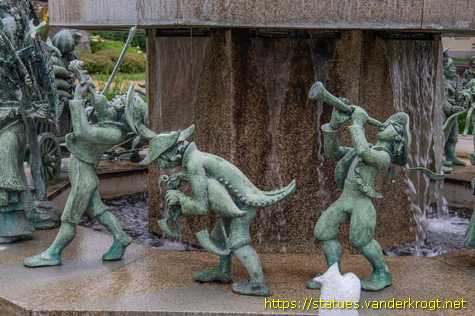 Geige, Dudelsack und Klarinette Violin, bagpipes and clarinet |
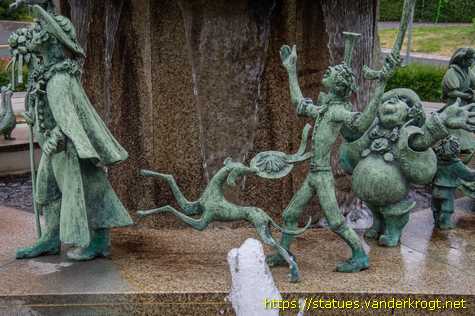 Hochzeitslader und die beide Schützen The wedding crier and the two marksmen |
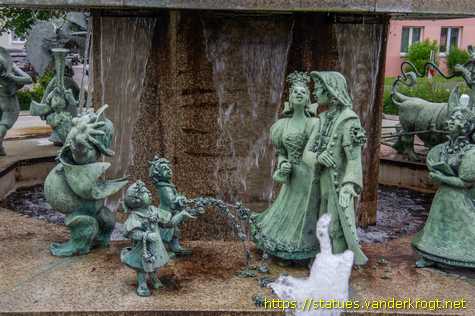 Das Brautpaar The bride and groom |
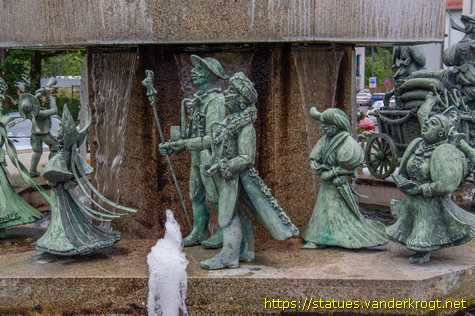 Gefolge des Brautpaars The bride and groom’s retinue |
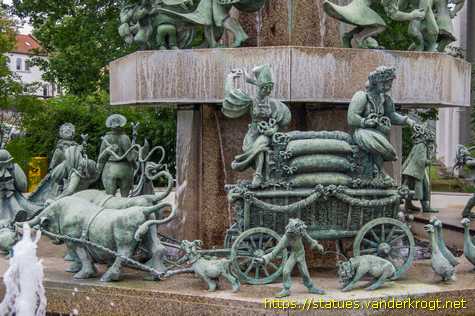 Der Kammerwagen mit dem Heiratsgut der Braut und Ziegenpeter The covered wagon carrying the bride’s dowry and Ziegenpeter |
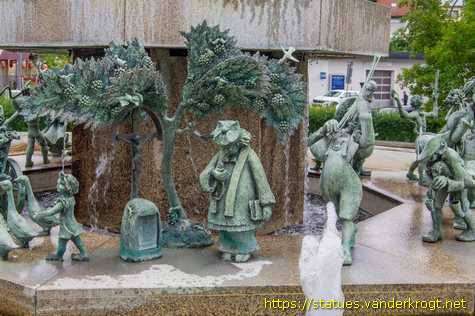 Gänseliesel [Hans mit dem Glucksschwein], Vogelbeerbaum, Marterl und Pfarrer Gänseliesel [Hans with the lucky pig], rowan tree, wayside shrine and the vicar. |
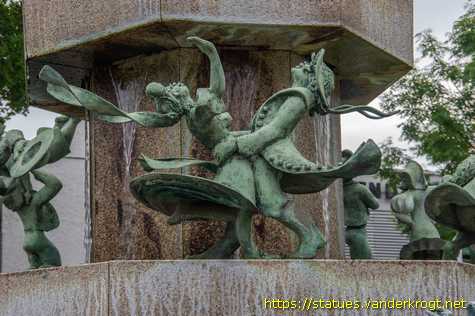
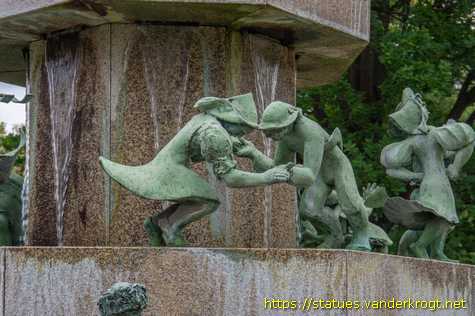
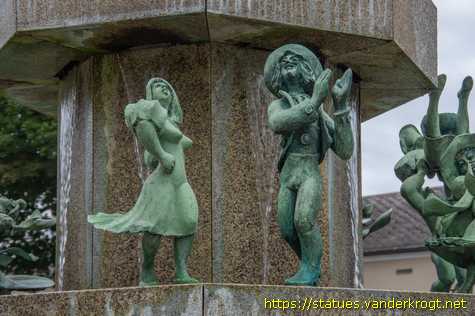
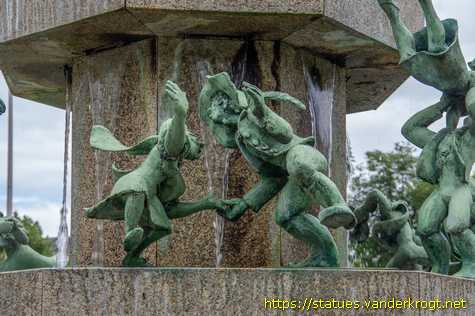
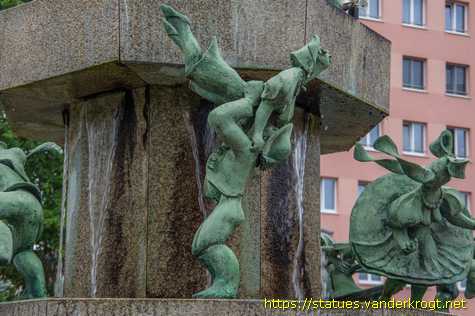
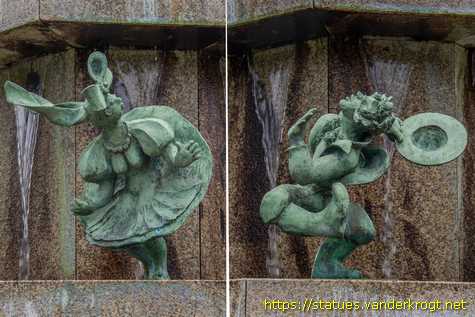
In der zweiten Ebene sind sechs Tanzpaare zu sehen. Mit ihnen wird die sprichwörtliche Tanzlust der Egerländer verdeutlicht. Zugleich erinnern sie an den "Roja", einen mittelalterlichen Reigentanz, der sich im Egerland bis in unsere Tage erhalten hat.
On the second level, six dancing couples can be seen. They illustrate the proverbial love of dancing among the people of the Egerland. At the same time, they are a reminder of the ‘Roja’, a medieval round dance that has survived in the Egerland to this day.
|
|
|
|
|
|
| Sechs Tanzpaare / Six dancing couples | |
In der dritten Ebene spielt eine "Große Bauernmusik" zum Tanz auf. Sie hat eine fur das Egerland typische und auf der Welt einmalige Besetzung aus Geige, Dudelsack, Klarinette, Harfe und Kontrabass.
On the third level, a 'large peasant band' plays music for the dance. It features an ensemble typical of the Egerland region and unique in the world, comprising violin, bagpipes, clarinet, harp and double bass.
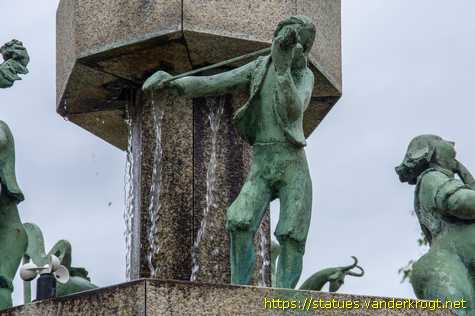 Geige Violin |
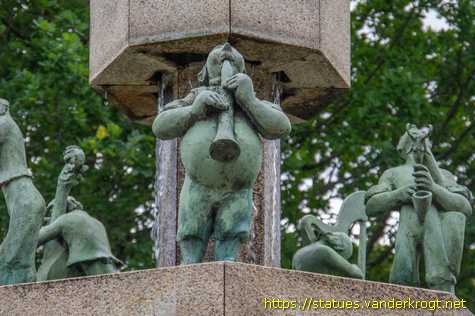 Klarinette clarinet |
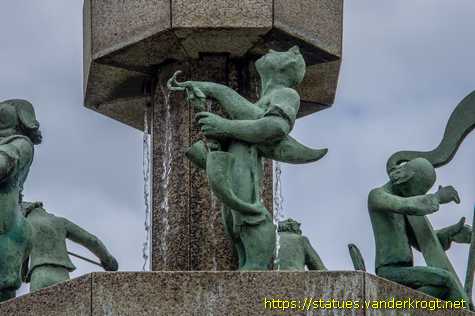 Dudelsack bagpipes |
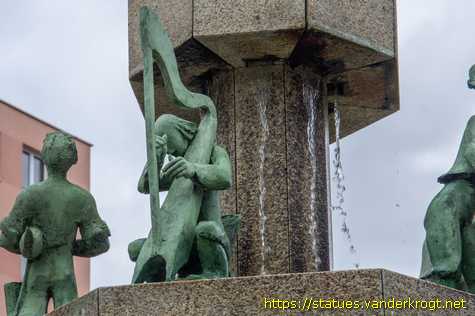 Harfe harp |
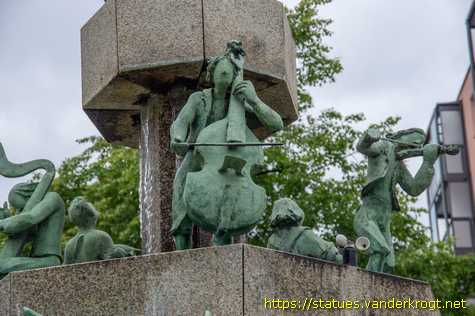 Kontrabass double bass |
|
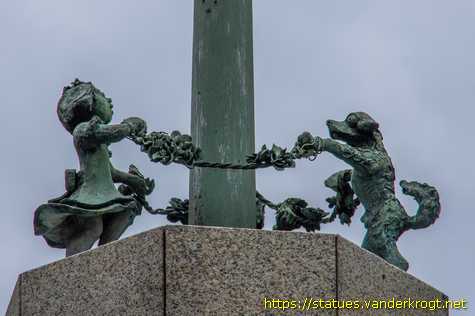
Die vierte Ebene wird von einem Kindertanzpaar belebt, das zusammen mit einem Hund um den Pfosten des Taubenhauses tanzt.
The fourth level is brought to life by a pair of children dancing together with a dog around the post of the dovecote.
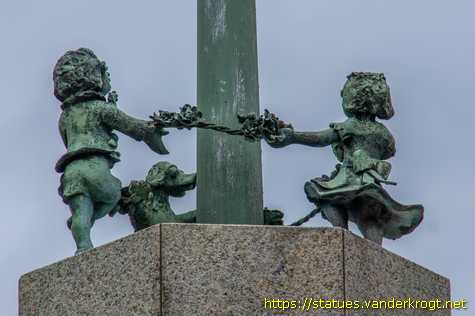
|
|
| Kindertanzpaar mit einem Hund / A pair of children dancing with a dog. | |
Der Figurenbaum endet in einem Taubenhaus, das in keinem Egerländer Bauernhof fehlen durfte.
The figure-adorned tree culminates in a dovecote, a feature that was an essential part of every Egerland farmstead.
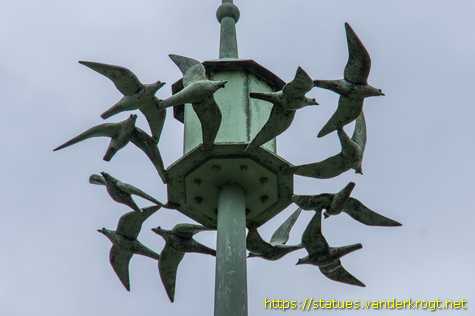
Taubenhaus mit Tauben / Dovecote with flying pigeons |
Der Egerlandbrunnen wurde auf Anregung von Seff Heil, dem im Jahre 2000 verstorbenen Bundesvuarstäiha der Egerländer, gebaut. Die Entstehungskosten wurden alleine durch Spenden und Figurenpatenschaften der Egerländer aufgebracht.
Die Egerländer Kunstler Hatto und Christoph Zeidler haben alle Figuren modelliert und auch die Brunnenarchitektur entworfen.
The Egerland Fountain was built at the suggestion of Seff Heil, the Federal Representative of the Egerlanders, who passed away in 2000. The construction costs were covered entirely by donations and figure sponsorships from the Egerlanders. The Egerland artists Hatto and Christoph Zeidler modelled all the figures and also designed the fountain’s architecture.
|
EGERLANDBRUNNEN CHEBSKÅ KAŠNA Der Egerlandbrunnen wurde am 3. September 2005 anlässlich des Egerlandtages eingeweiht. Er wurde von den Egerländer Kunstlern Hatto und Christoph Zeidler gestaltet und nimmt typische Motive aus dem Egerland auf. So erinnert die achteckige Form an den traditionellen Schmuckknopf der Egerländer Männertracht. Die Bronzefiguren des Brunnens stellen auf vier Ebenen den Hochzeitszug einer Egerländer Bauernhochzeit dar. Chebská kašna (Egerlandbrunnen) byla slavnostně odhalena 3. září 2005 u příležitosti Chebského dne (Egerlandtag). Osmiúhlá kašna je dílem umělců z historického území Chebska (Egerlandu) a na čtyřech etážích zobrazuje typickou Egerlandskou selskou svatbu. |
EGERLAND FOUNTAIN The Egerland Fountain was unveiled on 3 September 2005 to mark Egerland Day. It was designed by the Egerland artists Hatto and Ch ristoph Zeidler and incorporates typical motifs from the Egerland region. For example, the octagonal shape is reminiscent of the traditional decorative button found on the Egerland men’s traditional costume. The bronze figures on the fountain depict, across four levels, the wedding procession of an Egerland peasant wedding. [Czech text:] The Cheb Fountain (Egerlandbrunnen) was officially unveiled on 3 September 2005 to mark Cheb Day (Egerlandtag). The octagonal fountain is the work of artists from the historic region of Cheb (Egerland) and depicts a typical Egerland peasant wedding across its four tiers. |
|
|
|
|

Your banner here? Click for information.