Description
The Grand Calvary of Saint-Thégonnec dates from 1610.
The base
On the base are groups of figures illustrating scenes from the Passion.


East (Flogging, Ecce homo, Pilate washes his hands, Departure to the Way of the Cross) |

South (Arrestation, the mocking of Christ) |

West (Entombment and Resurrection) |
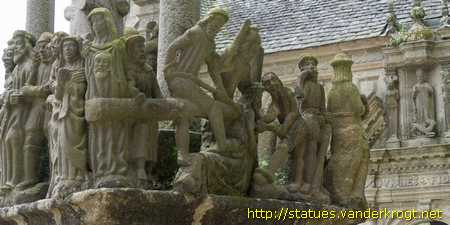
North (Way of the Cross) |

The mocking of Christ |

Flogging of Christ |

Ecce homo |
In a niche is a statue of St Thegonnec, accompanied as always by a wolf with chariot.
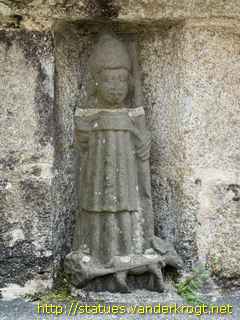
Saint-Thégonnec
The Cross
The platform is surmounted by a cross with two crosspieces supporting figures and two simpler crosses for the two thieves.
The central cross has the corpus on the main side (west), with angels collecting Christ's blood. On the pedestal of the cross is on the west side the Virgin and Child and on a east side Our Lady of Pity (Pietà), flanked by twin statues St. John the Apostle / St. Yves and St. Peter / Virgin Mary. On the higher brace are two riders, in the center is the date 1610 and some angels on the west side and Christ bound on the east side.

Pieta (on the Cross) |
Calvary (calvaire)
Calvary or Golgotha was the site, outside of ancient Jerusalem's early first century walls, at which the crucifixion of Jesus occurred. In religius sculpture, a calvary is a type of monumental public crucifix with two or more adjoining statues.
In northern France, Belgium, and southern Netherlands calvaries were erected at the junction of routes and tracks or on cemeteries, usually showing the crucifix with statues of Saint John the Apostle and Saint Mary Magdalena.
The calvaire in Bretagne is distinguished from a simple crucifix cross by the inclusion of three-dimensional figures surrounding the Crucifixion itself, typically representing Mary and the apostles of Jesus, though later saints and symbolic figures may also be depicted.
In Central Europe, a calvary is a complex of shrines or chapels containing not only the sculpture or painting of Crucifixion of Jesus, but all the Stations of the Cross.
(Wikipedia).
Artist
- Roland Doré (1618-1660),
sculptor of Landerneau, famous for his work on calvaries
(Wikipedia).
Sources & Information
- Yannick Pelletier, Saint-Thégonnec (éditions Jean-Paul Gisserot, 2009).
- Yannick Pelletier, Les enclos bretons (éditions Jean-Paul Gisserot, 2003).
- Eugène Royer et Joël Bigot, Calvaires bretons (éditions Jean-Paul Gisserot, 2005).
- Y.-P. Castel (webversion Y. Autret), L'atlas des croix et calvaires du Finistère.
Tags
Location (N 48°31'12" - W 3°56'47") (Satellite view: Google Maps)
Item Code: frbr115; Photograph: 31 May 2012
Of each statue we made photos from various angles and also detail photos of the various texts.
If you want to use photos, please contact us via the contact form (in Dutch, English or German).
© Website and photos: René & Peter van der Krogt

Your banner here? Click for information.

