Statues - Hither & Thither |
Site Search:
|
|
London
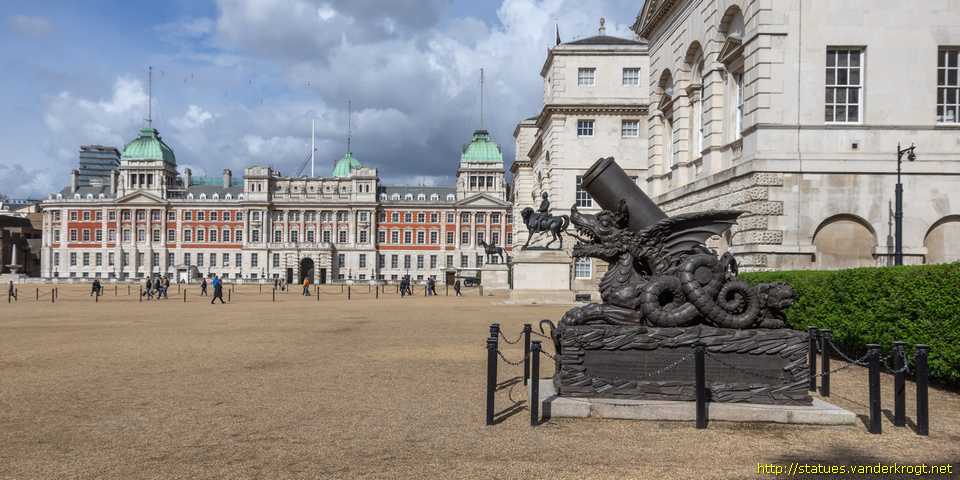
London Greater London Horse Guards Parade (SW1) |
Cádiz Memorialalso known as the Prince Regent's Bomb |
William Cuppage
Royal Arsenal (Woolwich) 1816 |
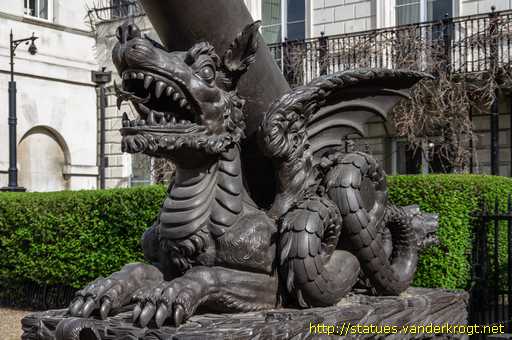
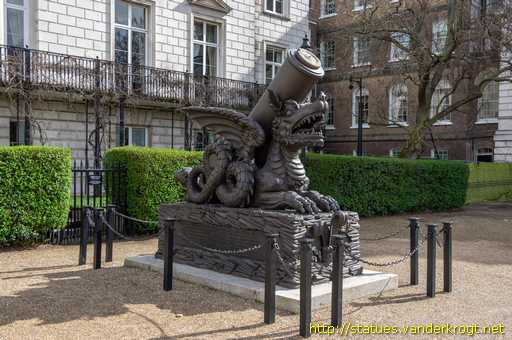
Mortar mounted on the back of a large brass sculpture of Dante's reimagining of the monster Geryon - fearsome giant who dwelt on the island Erytheia of the mythic Hesperides in the far west of the Mediterranean (by some wrongly described as a 'Chinese dragon'), associated with the Isle of Gades on which Cádiz stands, with twin tails twisting round to the vent of the mortar which it supports on its back. At the rear of the mortar is a sculpture of the dog Orthrus.
A complete description of its origin was given in the Hereford Journal of 14 August 1816:This extraordinary Mortar was used the French at the siege ot Cadiz, and was taken from them the English on the 25th of June, 1810. It weighs nearly five tons, and was one of several which Napoleon ordered to be cast at Seville, in Spain, with a view their future service at the siege of Gibraltar, which he was then meditating; hence they were called Bonaparte's favourite mortars. Being, from its unparalleled size, incapable of throwing shells, it was filled with lead, which it threw a distance of three miles over Bay into Fort St. Mary's; and it actually discharged a ball, with effect, three rules and a half. The Mortar was landed with one of less size at Woolwich, in the same year.
This remarkable instrument of war, considered an object of exhibition, as a military trophy, orders were issued for constructing a carriage suitable to its size and purpose; and model was sent to Carlton House, where it was placed in the gardens for the inspection of the Prince Regent. The parade in St. James's Park being fixed as the site, a foundation was accordingly prepared near the iron railing, at the end of the canal, consisting of five elm planks, of about four inches thick, measuring in length eleven feet nine inches, and six feet ten inches in width, with crossed planks under them of similar dimensions. The top of this foundation is paved, and on this pavement is placed an iron pediment, whereon the Mortar itself rests with its carriage.
The Mortar received a severe contusion in the face, whilst in the possession of the French, by a cannon shot from a British gun, the effects of which are visible.
From 1810, the Mortar had laid on the gun wharf, at Woolwich, until Friday, 2d of August, when was removed from thence, by eight artillery horses, and elevated to its present station, keep company with the long gun, a Turkish cannon, brought some years ago from Egypt, which displaced the beautiful piece of ordnance formerly so much admired, and so well known by the name of the "Queen's Gun."
The Carriage of this Mortar is an immense non-descript animal, of monstrous shape and terrible aspect, exciting the surprise of all who have yet seen it. The Mortar lays on its back, between its wings, which are erect. Its head of prodigious appearance; — it was intended to place a grenade, with the fuse burning, in its open mouth - and in this way the figure was modelled; but it has been thought proper to substitute a barbed tongue, which projects if threatening the beholder. Its tail is forked or split, and winds on each side over the back, into circles, which receive the trunnions the Mortar. At each hind corner of the pedestal is a war-dog.
This extraordinary figure is of gun metal; it was cast at the foundery of the Royal Arsenal at Woolwich, under the direction of General Cuppage, who has had the entire superintendance of the ornamental part of the trophy. It has been four years in completing, under the immediate inspection of the General. Some idea of the size of the figure may be formed from each of its wings weighing 6cwt. 25lbs. — One of the wings was cast heavier than the other, but has been clipped to the proper weight. The carriage has become familiarly known amongst the workmen by the name "General Cuppage's Devil."
The Kentish Gazette knew the mythological origin of the 'beast:
An emblem has been selected (in allegorical allusion to the means by which the siege of Cadiz was terminated) from the labours of Hercules, who destroyed the monster Geryon, the tyrant of the Isle ot Gades, thus figuratively describing the raising the siege, and illustrate the fame of the hero who had broken the enchantment of the modern Geryon,
The mortar was one of a number of giant siege weapons used by the French army under Marshal Soult during the two-year siege of Cádiz.
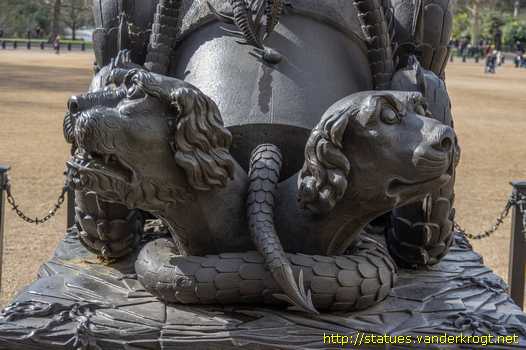 Orthrus, the two-headed dog who guarded Geryon's cattle and was killed by Heracles |
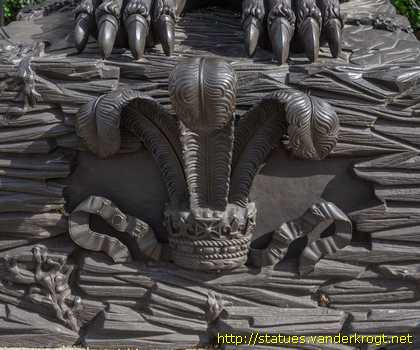 The feathers of the Prince of Wales. |
|
Devictis, a WELLINGTON DUCE prope SALAMANCAM, GALLIS Solutâque exinde GADIUM obsidione, hanc quam aspicitis Basi superimpositam BOMBARDAM, Vi Præditam adhuc inauditâ Ad urbem portumque GADITANUM destruendum, conflatam, Et a copiis turbatis relictam, CORTES HISPANICI pristinorum haudquaquam Beneficiorum obliti, summæ venerationis testiminio donaverunt GEORGIO ILLUS. BRIT. PRINC. Qui, in perpetuam rei memoriam, hoc loco ponendam, et his ormanentis decorandam, jussit. |
|
TO COMMEMORATE The raising of the siege of CADIZ, in consequence of the glorious VICTORY, obtained by the DUKE of WELLINGTON Over the french near SALAMANCA, on the xxii of july mdcccxii. This MORTAR, cast for the destruction of that great port, with powers surpassing all others, And abandoned by the BESIEGERS on their RETREAT, Was presented as a token of respect and gratitude by the SPANISH NATION To his ROYAL HIGHNESS the PRINCE REGENT |
|
Constructed in the Carriage Department, Royal Arsenal — EARL of MULGRAVE Master General 1814 |
|
|
|
|

Your banner here? Click for information.