Statues - Hither & Thither |
Site Search:
|
|
Leeds
West Yorkshire Yorkshire & Humberside City Square |
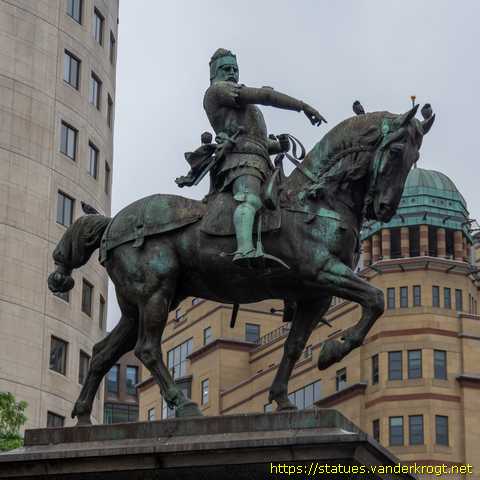
Edward the Black PrinceWoodstock Palace 1330 - Westminster Palace 1376eldest son of King Edward III; one of the most successful English commanders during the Hundred Years' War (Wikipedia) |
Thomas Brock
1903 |
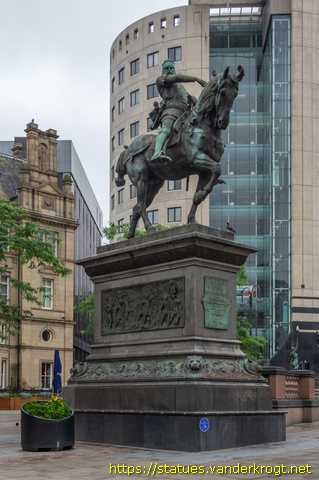
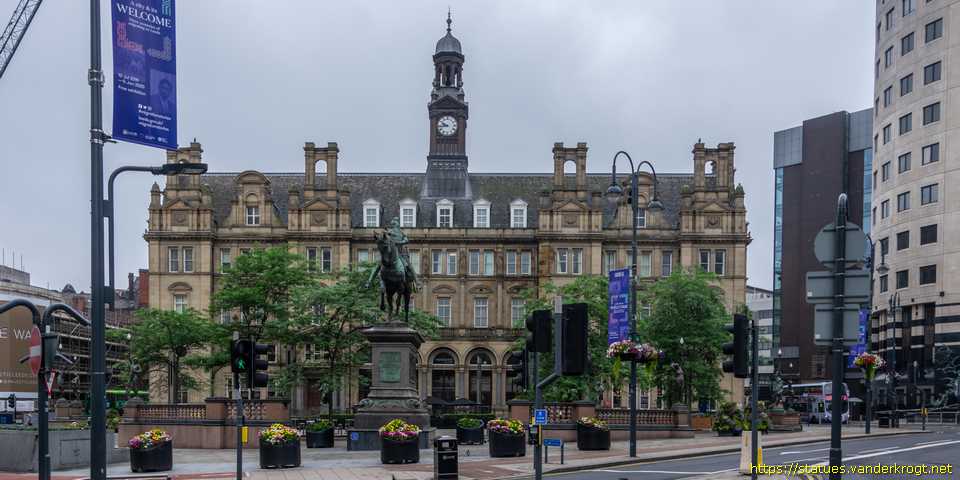
Equestrian statue of Edward the Black Prince in chain mail armour with helmet and sword. The design was based on the Black Prince's effigy and accoutrements in Canterbury Cathedral.
Prince Edward has no specific connection with Leeds. In his speech at the unveiling, Thomas Harding explains why a statue of him was placed in Leeds:
The hero of Crecy and Poitiers, the uphoJder of the rights of the people, the Black Prince, would remain there as an emblem of chivalry, of those unselfish virtues which in all ages went make a great and a true people. The period of the Black Prince was one of peculiar historical interest. After the troubles of the Norman Conquest, England had the advantage of a monarch and a Prince of Wales who were not only popular, but who were beloved by the people. Then it was that England began take her place amongst the nations of the world; it was the day of Chaucer, and the beginning of English literature. Our institutions sprung from that period, and it was then our commerce was founded.
(...)in the old Coloured Cloth Hall, which stood on that site, it had been said there was a panel containing a picture of the Black Prince. It turned out on investigation, however, that it was the picture of the Black Prince's father. Edward III. One of the old trustees had written stating that the reason it was put there was that the policy of Edward III had started the woollen trade in the West Riding. This pre-existing connection of the age of the Black Prince with the old Coloured Cloth Hall added yet another interest to the monument they were that day inaugurating. He trusted, in conclusion, that the statuary would add yet another claim to Leeds being a great city.
On the pedestal are two reliefs:
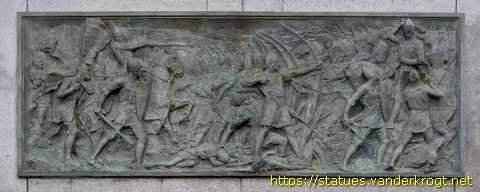 Battle on the land in the 14th century, probably the Battle of Crécy (1346) with the famous English long bow, or that of Poitiers (1356), where the prince captured the King of France (Victorian Web). |
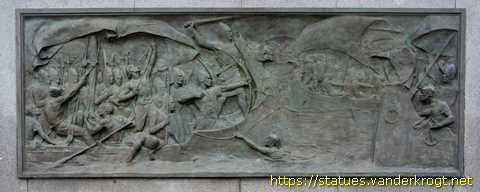 Naval battle in the 14th century, probably the battle of Winchelsea or of Les Espagnols sur Mer (1350) - it is often referred to as the battle of Sluis (1340); but as the Prince was only 10 years old at the time, that is not very likely (Victorian Web). |
Directly under the pedestal is a frieze with the Royal arms of England and the Black Prince's 'shield for peace' (a black shield with three white ostrich feathers).
Between the pedestal and the base is a frieze with leaves and leopard's heads on the corner. In the leaves the following names were written:
The statue was, together with the other statues on the then new City Square, unveiled at 16 September 1903 with this schedule:
11.30 a.m. City Council and Lord Mayor's guests to assemble Town Hall.
11.45 a.m. The Lord Mayor (Mr. John Ward) and the Town Clerk (Mr. W. J. Jeeves) to head proccesion via East Parade and Infirmary Street to the City Square.
12 noon. Colonel Harding will formally hand over the statue of the Black Prince and other monuments and ornamental lamps to the Corporation.
Councillor Boston will present tihe statue of John Harrison, and Mr. W. Wainwright, on behalf of the late Mr. Richard Wainwright, will hand over the figure of James Watt.
The Lord Mayor will accept these several gifts on behalf of the city.
12.30 p.m. Procession will return the Town Hall, where tho freedom the city will be conferred upon Ald. Harding, D.L.
1.30 p.m. Luncheon in the City Art Gallery.
|
EDWARD prince of wales svrnamed THE BLACK PRINCE the hero of CRECY and POITIERS THE FLOWER of ENGLAND'S CHIVALRY the vpholder of the rights of the people in the GOOD PARLIAMENT |
the gift of T. WALTER HARDING lord mayor 1898-1899 — erected 1903 t. brock r.a.sc
|

Your banner here? Click for information.