

Statues - Hither & Thither |
Site Search:
|
|
Whitby
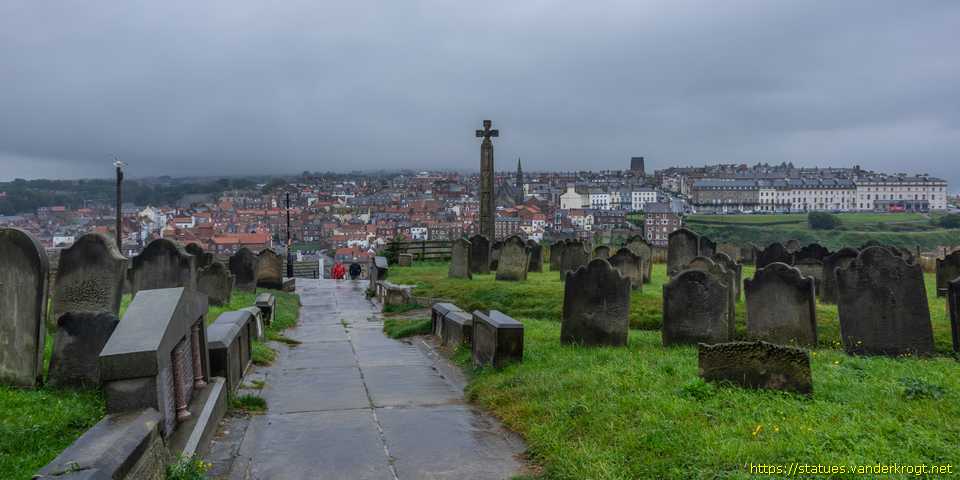
North Yorkshire Yorkshire & Humberside Church Lane / 199 Steps
|
Cædmon's Cross |
Charles C. Hodges & Robert Beall
1898 |
Stone cross with reliefs on all faces.
Description of the monument from a page of a journal which hangs in a frame in St. Mary's Church:
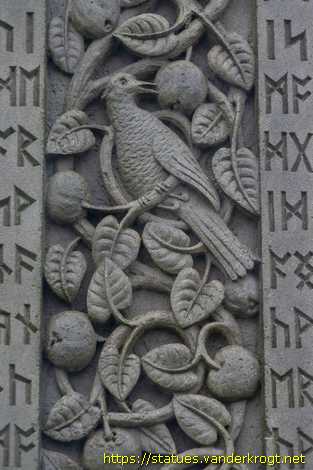
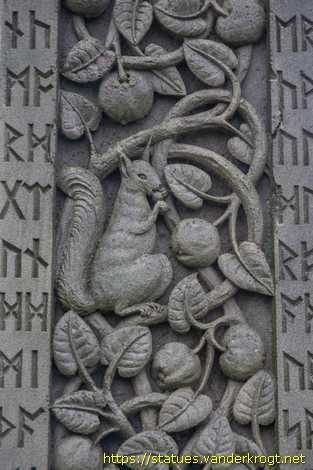
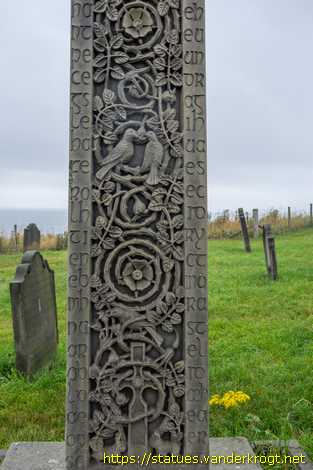
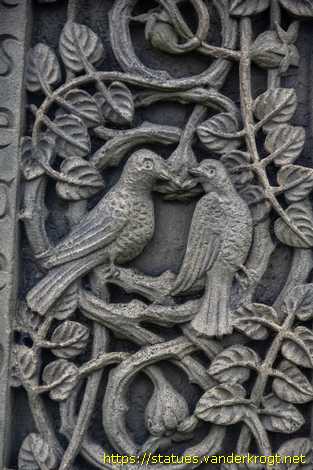
The monument erected here to his memory takes the form of an Anglian Cross, embodying the ornament and general treatment of the Northumbria of Cædmon's time, as shewn in the four great contemporary crosses of Bewcastle, Ruthwell, Rothbury, and Hexham, erected towards the end of the seventh century. The Caedmon Cross, standing twenty feet high, is hewn out of the fine grained hard sandstone of the Black Pasture Quarry in Northumberland. Upon its front are carved panels of the Christ in the act of blessing, of David playing the harp, of the Abbess Hild, and of Cædmon in the stable inspired to sing his great song. On the arms of the Cross above are the symbols of the four evangelists, and the Agnus Dei in the centre. Below is the inscription: — "To the Glory of God, and in memory of His servant Cædmon. Fell asleep hard by A.D. 680." On the obverse is carved a double vine symbolical of Christ, and in the loops are found figures of the four great scholars trained at Whitby in Cædmon's time, under Abbess Hild, namely, Bosa, Aetla, Oftson, and John (afterwards of Beverley). On the arms of the Cross above are bosses and knot-work with the emblem of the dove and the letters Alpha and Omega. Beneath are inscribed the first nine lines of Cædmon's Hymn of the Creation, as preserved to us on the flyleaf of the Moore Bæda in the Cambridge Museum, and as carefully rendered into English by the Anglo-Saxon Professors at Oxford and Cambridge. The runes of the same nine lines are also carved on the border of one of the sides of the Cross, and the same inscription appears in Saxon Mimuscule on the border of the opposite side. The two sides of the Cross contain respectively a conventionalised English wild rose with birds and animals, and an apple tree emblematical of Eden, conventionalised also with other birds and animals. The symbolism of these sides is intended to teach that all gentle life under the protection of the Cross of Christ should abound and be happy. A harp is seen at the foot of the Tree of Life, as emblematical of the harmony which Christ restored, and as suggestive of the immortality of Christian song; and the wild roses, the badge of St. George, spring from an old Iona Cross, typifying that the life of the Christian Church ran on and bore fruit and flower at Whitby.
For this magnificent work of art, Whitby is chiefly indebted to Canon Rawnsley, Vicar of Crosthwaite. It was he who originated the Memorial, and worked at it untiringly till it was brought to a successful issue. The design was made and its execution superintended by Mr. C.C. Hodges, the well-known antiquary and expert in Anglo-Saxon detail. Messrs. Beale, Sculptors, of Newcastle, executed the design. The unveiling of the Memorial took place in brilliant sunshine and under favouring circumstances on September 21st, 1898, in the presence of a great gathering. A Hymn of Praise, adapted from Caedmon's Hymn of the Creation, was sung. The Bishop of Hull offered up a special prayer, and at the request of the Rev. Marquis of Normanby (the Chairman of the Committee), the Poet Laureate (Alfred Austen, Esq.) unveiled the monument.
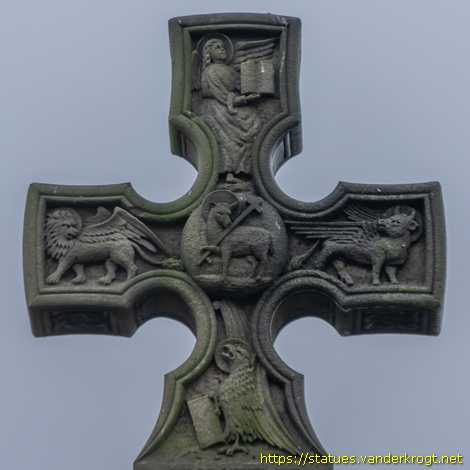 The Lamb of God and the symbols of the four evangelists. |
|||
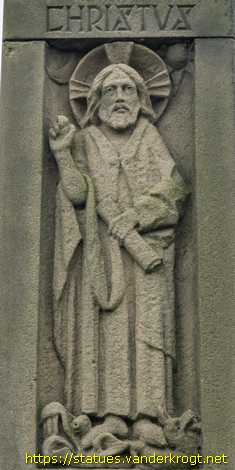 christvs |
 david David (c. 1040-970 BCE), second king of the United Kingdom of Israel, and an ancestor of Jesus (Wikipedia). |
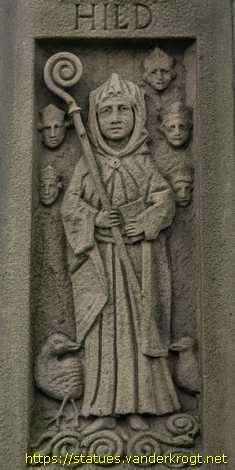 hild St. Hilda of Whitby (c. 614 - 680), founding abbess of the monastery at Whitby (Wikipedia). |
 Cædmon Cædmon (fl. c. 657–684), the earliest English (Northumbrian) poet whose name is known; he lived in Whitby (Wikipedia). |
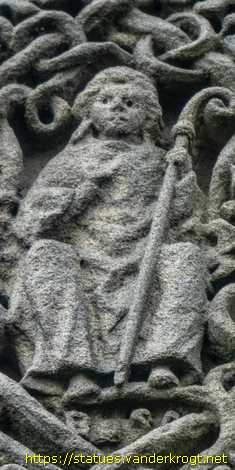 bosa Bosa, Bishop of York, scholar of Whitby at Cædmon's time. |
 aetla Ætla, Bishop of Doncaster, scholar of Whitby at Cædmon's time. |
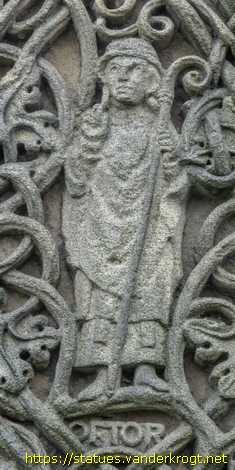 oftson Oftor, Oftgar or Oftson, Bishop of Winchester, scholar of Whitby at Cædmon's time. |
 iohn St. John of Beverley (died 721), English bishop active in the kingdom of Northumbria (Wikipedia). |
 |
 |
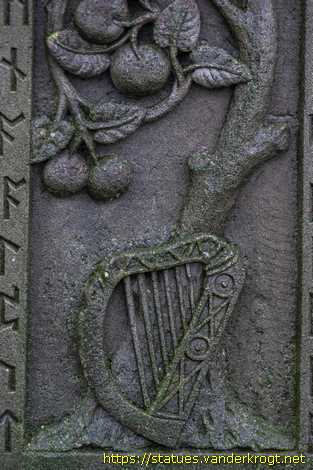 |
| Right: a harp and a tree of life with squirrels and birds, on the borders Cædmon's Hymn of the Creation in runes. | ||
 |
 |
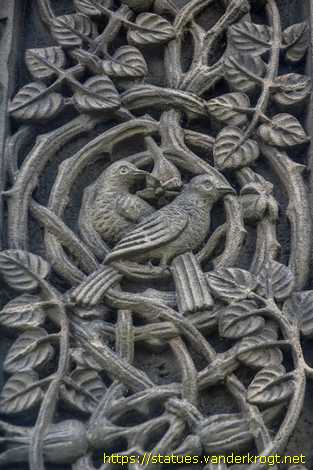 |
| Left: a celtic cross, English wild roses with birds, on the borders Cædmon's Hymn of the Creation in Saxon Mimuscule. | ||
|
Front: Dedication |
Right: Cædmon's Hymn of the Creation |
Left: Designers and sculptor |
|
to the glory of god and in memory of cædmon the father of english sacred song fell asleep hard by 680 |
"now mvst we... the gvardian [of heaven] the creator might and his mind[s thov]ght the gloriovs works of the father how of every wonder he the lord eternal laid the fovndation. he shared erst for the sons of men heaven as their roof holy [cre]ator the middle world he mankinds gvardian eternal lord afterwards prepared the earth for men lord almighty. this was the first song cædmon sang |
21 september 1898 h.d. rawnsley c.c. hodges r. beall inv. et direx. sculpt |

Your banner here? Click for information.